
A Personalized Lens Example for Everyday Life

A personalized lens example is easiest to understand when you picture a real day, not a prescription written on paper. Consider a Cypress professional who spends mornings on a laptop, checks messages between meetings, drives home after dark, and reads in the evening. Their eyes do not perform one task all day, so their lenses should not be chosen as though they do.
The prescription is the starting point. The personal part comes from how that prescription is designed, measured, positioned in the frame, and matched to the way someone actually moves through daily life. That is where sharper vision can feel more natural, progressive lenses can feel easier to adapt to, and a favorite frame can remain comfortable from the first appointment to the end of a long day.
What a personalized lens really means
Personalized lenses are not simply premium lenses with a higher price tag. They are lenses selected and customized around the wearer, their prescription, frame choice, visual habits, and fitting measurements.
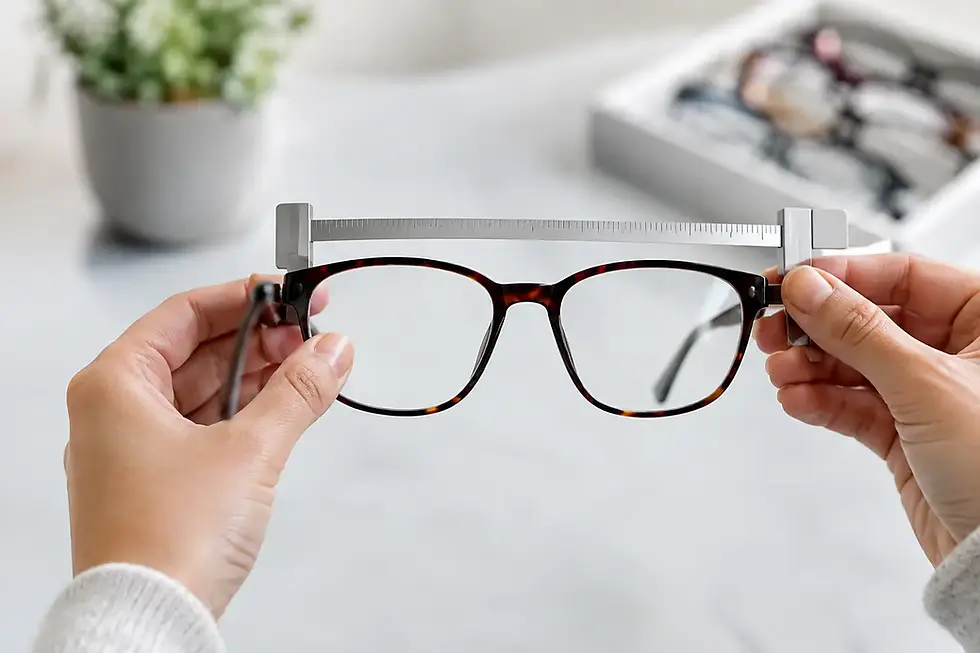
A standard lens design may use general assumptions about how a person holds reading material, where their eyes sit in a frame, or how they turn their head to look through different zones. A personalized design replaces more of those assumptions with real measurements. For progressive lenses, this can include the frame's position on the face, vertex distance, pantoscopic tilt, wrap angle, and the precise location of each pupil behind the lenses.
These details matter because a lens only works as designed when its optics align with the wearer’s eyes. A beautifully made progressive lens can still feel narrow, swimmy, or uncomfortable if it is not fitted with care. Conversely, careful measurements and a well-chosen design can make a meaningful difference in how quickly a wearer settles into a new prescription.
Personalization also means restraint. Not every client needs the most complex lens design or every available treatment. Someone who wears single-vision glasses primarily for distance may benefit most from an accurate prescription, a thoughtful frame fit, and a durable anti-reflective coating. A frequent nighttime driver with progressive needs has a different set of priorities.
A personalized lens example: one pair, many demands
Imagine a client in their late 40s who has begun removing their glasses to read a phone. They are mildly nearsighted with astigmatism and now need near support as well. They want one pair of glasses for work, errands, travel, and dinner out, and they have chosen a refined independent frame with a slightly wrapped shape.
The first question is not, “Which progressive is on sale?” It is, “Where do your eyes spend the day?” This client works on two monitors, often glances down at notes, uses a phone frequently, drives Houston-area roads after sunset, and wants to see a restaurant menu without changing glasses.
A carefully tailored progressive lens could be the right answer. The optician begins with a current refraction and then evaluates the selected frame on the client’s face. The frame must sit at a stable, comfortable height. Its bridge must support the weight properly, its temples must follow the head without pressure, and the lens height must provide enough room for the progressive design.
Once the frame is adjusted, precise fitting measurements are taken while the client wears it naturally. The measurements are not a formality. If the frame later slides down or is bent out of position, the visual zones move with it. This is why professional adjustment and ongoing care are part of the lens experience, not an afterthought.
For this client, a ZEISS SmartLife Individual 3 progressive design may be considered, depending on the prescription and visual needs. Its personalization options are intended to account for the wearer’s age-related visual behavior, frame parameters, and individual viewing habits. The goal is practical: clearer access to the laptop, phone, dashboard, and distance view without constantly searching for the right spot in the lens.
The client may also choose a premium anti-reflective coating. This helps reduce distracting reflections from overhead lighting, screens, and headlights while making the lenses appear cleaner and more transparent. For someone who drives at night often, a ZEISS DriveSafe option may be worth discussing. It is designed around common driving challenges, including glare and frequent shifts between the road, mirrors, and dashboard. It is not a substitute for safe driving habits, but it can be a thoughtful part of a driving-focused eyewear plan.
That is a personalized lens example in practice: the prescription is only one piece. The final pair is built around work distance, driving conditions, near tasks, frame geometry, facial measurements, and the client’s preference for one polished pair that can keep up.
Why frame choice changes the lens conversation
Frames are personal style, but they are also optical equipment. A deep, well-fitted frame can offer more room for progressive zones. A very shallow frame may limit design choices. A strongly wrapped sunglass frame may require lens calculations that account for its curve. A delicate frame may call for a lens material that balances thinness, weight, durability, and optical quality.
This is one reason selecting a frame before finalizing the lens is so helpful. The right independent frame should complement the person wearing it, but it also has to support the vision they need. No rushing, no pressure - just a candid conversation about what will look good and perform well.
For example, a client who spends most of the day outdoors may prefer prescription sun lenses with polarized glare reduction. A parent who moves between school pickup, computer work, and evening reading may prefer photochromic lenses that darken outdoors and remain clear inside. A person with a high prescription may prioritize a frame shape that keeps the lens edges more balanced and the overall pair lighter.
There is rarely one universally best choice. There is a best choice for the wearer’s routine.
The details that make lenses feel better all day
Comfort is often discussed as a frame issue, but lens choices influence it too. Heavier lenses can cause a frame to creep down the nose. Poorly centered optical zones can encourage head tilting or eye strain. An overly ambitious all-purpose design can disappoint if it does not give enough emphasis to the task that dominates the day.
During a personal consultation, it helps to be specific about the moments that frustrate you. Mention if street signs blur at night, if you lean toward the screen, if reading requires taking off your glasses, or if you avoid progressives because a previous pair felt difficult. These are useful clues, not minor complaints.
An experienced optician can also explain the trade-offs. A progressive lens designed to prioritize a broad intermediate zone for computer work may feel different from one built primarily for distance and general walking around. A photochromic lens offers convenience, but it may not darken as much behind many car windshields. Polarized sun lenses are excellent for reflected outdoor glare, yet they are a separate sunglass solution rather than a replacement for a clear everyday pair.
The right recommendation respects those realities. Your vision deserves more than a transaction or a generic menu of upgrades.
Personalization continues after pickup
The first wear is valuable feedback. New progressive wearers may need a short adjustment period, especially when moving from single-vision lenses or an older progressive design. Yet adaptation should not mean simply tolerating ongoing discomfort. If the lenses feel consistently off, the frame may need adjustment, the fitting height may need to be checked, or the lens design may need another conversation.
At Optica Caballero, the relationship does not end when the glasses leave the boutique. A frame can shift with daily wear, and a small adjustment can restore both comfort and visual alignment. That continuing care protects the investment in a thoughtfully selected lens.
The most useful next step is simple: bring in the glasses you wear now and describe the moments when they fall short. From there, a personalized lens can become less of an abstract option and more of a practical answer to the way you actually see.


Comments