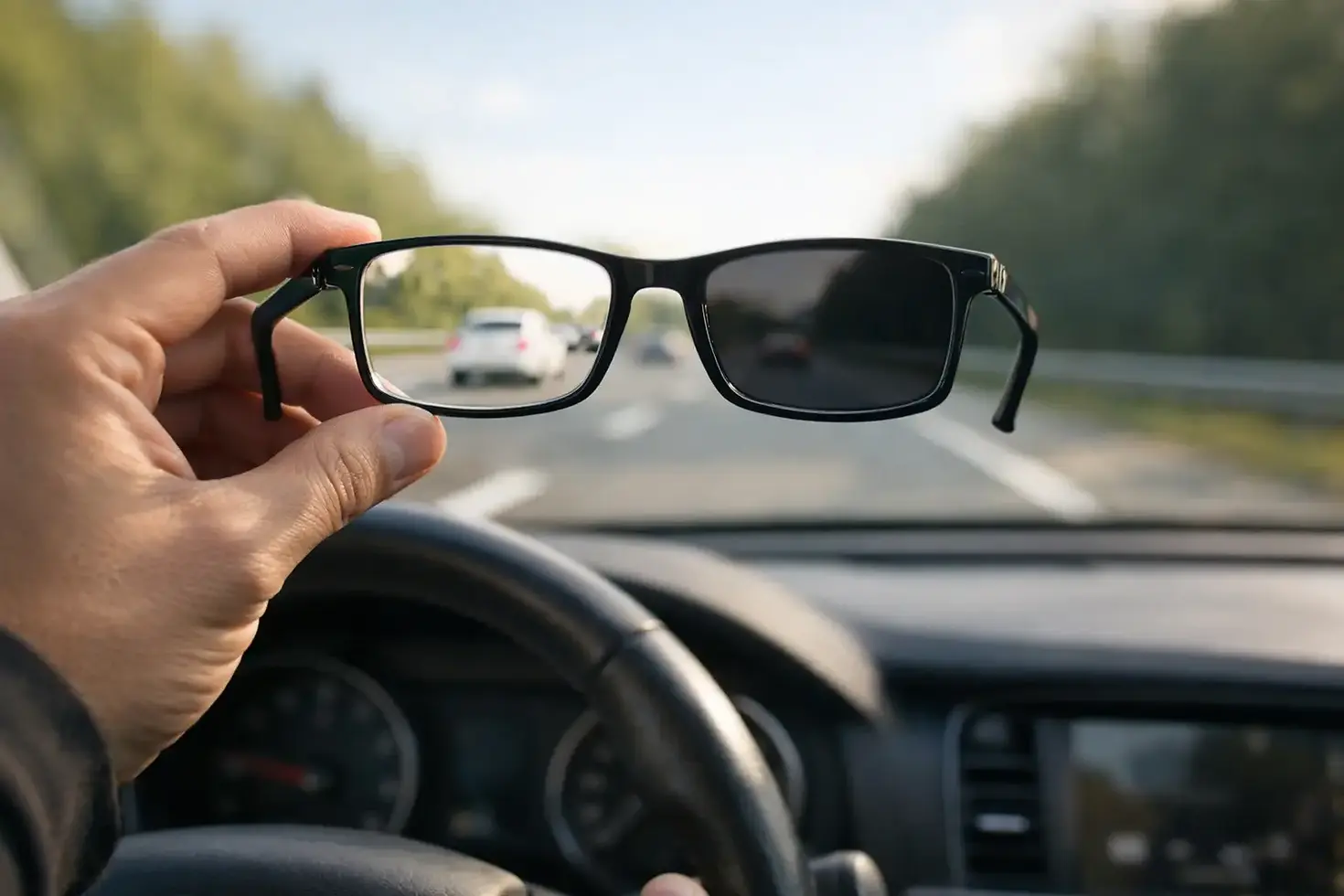
Do Photochromic Lenses Work in Cars While Driving?

A bright Houston afternoon can make the answer feel obvious: you step outside, your lenses darken, and glare becomes easier to manage. Then you get behind the wheel and wonder, do photochromic lenses work in cars the same way? Usually, no. Most standard photochromic lenses do not become fully dark behind a windshield, even in intense Texas sun.
That does not make them a poor choice. It simply means photochromic lenses and driving lenses solve related, but different, visual problems. The right choice depends on how much you drive, when you drive, whether you need a progressive prescription, and how strongly you prefer the convenience of one pair over the performance of a dedicated driving pair.
Why photochromic lenses stay lighter in a car
Traditional photochromic lenses react primarily to ultraviolet light. Outdoors, UV exposure activates the molecules in the lens, causing them to darken. Your car’s windshield, however, is designed to filter a large amount of UV light before it reaches you. That protection is good for your skin and interior surfaces, but it also limits the signal that tells standard photochromic lenses to change.
As a result, lenses that turn comfortably dark on a walk across a parking lot may remain mostly clear or only lightly tinted while you are driving. The effect can vary by vehicle, weather, lens material, and the specific photochromic technology, but expectations matter. A standard photochromic lens should not be selected as a substitute for prescription sunglasses if you spend significant time behind the wheel in full daylight.
Side windows can allow more UV through than the windshield, so you may notice some activation from the sides. That is still not the same as the even, sun-lens-level darkness many drivers expect.
Do photochromic lenses work in cars with newer technology?
Some newer photochromic options respond to a broader range of light, including portions of visible light. These lenses can activate more noticeably behind a windshield than traditional photochromics. For a driver who wants one everyday pair, this can be a meaningful improvement.
There is a trade-off. Lenses designed for stronger in-car activation may retain a slight tint indoors or take on a more noticeable residual shade. For some clients, that is a fair exchange for better comfort during commutes, school pickup, travel, and weekend errands. For others, especially those who want their lenses completely clear in meetings or under office lighting, it may not be the preferred fit.
This is where a conversation matters more than a quick upgrade at checkout. We take the time to ask when you drive, how sensitive you are to light, whether you work at a screen all day, and what you expect your glasses to do once you are in the car. No rushing, no pressure - just a lens recommendation built around your actual routine.
Photochromic lenses are excellent for the right kind of day
Photochromic lenses remain an exceptionally practical option for people who move frequently between indoors and outdoors. They are especially useful for walking the dog, attending outdoor events, visiting job sites, running errands, sitting on a patio, or moving from a bright parking lot into a store without changing glasses.
They also provide convenience for parents and busy professionals who do not always want to carry a second pair. A well-made photochromic lens paired with a precise prescription and premium anti-reflective coating can deliver crisp, comfortable vision through much of the day.
The limitation is specific: standard photochromic lenses are not optimized to become dark behind a UV-filtering windshield. If daytime driving is only a small part of your day, that may be perfectly acceptable. If driving is central to your work or lifestyle, it is worth considering a second solution.
Better lens options for frequent drivers
For many clients, the best answer is two pairs with two clear jobs: an everyday pair with photochromic lenses and a dedicated pair for driving. This is not about selling more eyewear for the sake of it. It is about avoiding compromises when the visual demands are very different.
Prescription sunglasses for bright daytime driving
A dedicated prescription sun lens provides dependable darkness every time you enter the car. It does not wait for UV activation, and it can be selected in a tint that feels comfortable for your sensitivity to light.
Polarized prescription sunglasses can be particularly helpful around water, wet roads, vehicle hoods, and reflective pavement because they reduce certain types of reflected glare. They are a strong choice for daytime driving, boating, golf, and outdoor weekends. However, polarization can make some dashboard displays, infotainment screens, and heads-up displays appear darker or less visible at certain angles. That is worth testing before deciding it is the right lens for your vehicle.
A non-polarized sun lens is often a smart alternative for drivers who rely heavily on digital displays. With the right tint, backside anti-reflective coating, and precise fit, it can provide very comfortable sun control without display interference.
Clear driving lenses for changing light and night driving
If glare from headlights, streetlights, rain-slick roads, or oncoming traffic bothers you after sunset, a clear driving lens may be more useful than a dark lens. Premium options such as ZEISS DriveSafe lenses are designed around the contrast and glare challenges drivers encounter in lower light.
A quality anti-reflective coating is especially valuable here. It helps reduce distracting reflections from the front and back surfaces of the lens, including the reflections that can appear from cabin lighting or illuminated displays. It also supports a cleaner appearance and easier lens care.
No lens can remove all night-driving glare, particularly in rain or with very bright LED headlights. But a current prescription, thoughtful lens design, and high-quality coating can make the visual environment feel more controlled and less tiring.
Progressive lenses require extra care behind the wheel
For progressive wearers, driving comfort is about more than tint. You need a wide, stable distance zone for the road, useful access to your dashboard and mirrors, and a fitting height that reflects your natural driving posture. A progressive lens can perform beautifully at a desk yet feel less comfortable in the car if it is not designed and fitted with those habits in mind.
Frame selection matters, too. A frame that sits too low, slides on the nose, or has a narrow vertical lens area can limit the usable viewing zones in a progressive. Precision measurements, proper adjustments, and a frame chosen for your face and prescription are not small details. They are part of how your lenses perform every mile.
How to choose without overcomplicating it
Start with the question that affects your eyes most often. If you primarily want effortless transitions between indoor spaces and outdoor errands, photochromic lenses may be an excellent everyday solution. If you drive daily in bright daylight, dedicated prescription sunglasses will usually provide more reliable comfort. If you find night driving stressful, prioritize a clear lens with an advanced anti-reflective coating and a current, carefully verified prescription.
Many people benefit from a combination: photochromic lenses in their daily frame, plus a driving pair that offers the specific tint, glare control, and coverage their commute demands. With independent frames and premium lens technology, that second pair can feel like a considered part of your wardrobe, not an afterthought kept in the console.
At Optica Caballero, the goal is not to give every client the same recommendation. Your vision deserves more than a transaction. Bring in the pair you wear most, tell us about your commute and your most difficult lighting conditions, and we can help you choose lenses that feel right from the first turn onto the road.



Comments