
Prescription Lens Materials Guide for Daily Comfort

A beautiful frame can make the first impression, but the lens material determines much of what you experience after you leave the optical shop: clarity, weight, thickness, durability, and comfort from morning through evening. This prescription lens materials guide is designed to make that choice feel less technical and more personal. The right answer depends on your prescription, frame selection, workday, driving habits, and how you want your eyewear to feel on your face.
At Optica Caballero, we take the time to get those details right. No rushing, no pressure - just thoughtful guidance toward lenses that suit the way you actually live.
Why Lens Material Matters Beyond Thickness
Lens materials are not interchangeable. Two pairs of glasses with the same prescription can look, feel, and perform quite differently depending on the material used. A lens may be lighter but more prone to surface reflections. Another may offer excellent impact resistance but need a more considered approach to optical clarity. A thinner lens can improve appearance in a stronger prescription, yet it is not automatically the best choice for every frame or lifestyle.
Material also works alongside lens design and coatings. A premium progressive design can make a meaningful difference in how naturally you move from phone to computer to distance vision. A high-quality anti-reflective coating can reduce distracting reflections and improve the cosmetic appearance of your lenses. For drivers, a purpose-built option such as ZEISS DriveSafe lenses may help address the glare and changing light conditions that make evening travel tiring.
The most successful eyewear decisions consider the complete system: prescription, material, design, coating, frame fit, and the visual tasks that fill your day.
Prescription Lens Materials Guide: The Main Options
CR-39 Plastic: Clear, Comfortable, and Dependable
CR-39 is a traditional optical plastic valued for its clear optics and approachable weight. It remains a strong choice for many single-vision prescriptions, especially when lens thickness is not a major concern. Compared with basic glass lenses, it is lighter and more comfortable for everyday wear.
For modest prescriptions in a full-rim frame, CR-39 can provide excellent visual quality without adding unnecessary cost. It is not as impact-resistant as polycarbonate or Trivex, so it may not be the first choice for active wear, children, or a frame that leaves the lens edge exposed. It can also become thicker than high-index materials as prescriptions increase.
Polycarbonate: Built for Impact Resistance
Polycarbonate lenses are known for their impact resistance and naturally built-in UV protection. They are a practical material for active lifestyles, safety-minded wearers, and children’s eyewear. They are also thinner and lighter than standard plastic in many prescriptions.
The trade-off is optical precision. Polycarbonate has a lower Abbe value, an optical measure associated with color fringing and peripheral clarity. Some wearers, particularly those with stronger prescriptions or sensitivity to visual distortion, notice more color separation or less crisp peripheral vision than they would in Trivex or a high-index material.
That does not make polycarbonate a poor lens. It makes it a specific solution. If impact resistance is the leading priority, it can be an appropriate and dependable choice. If you spend long hours reading fine type, working across multiple screens, or adapting to progressive lenses, it is worth discussing whether another material may offer a more refined visual experience.
Trivex: A Premium Balance of Clarity and Protection
Trivex is often an excellent choice for people who want impact resistance without giving up as much optical clarity. Like polycarbonate, it is lightweight, durable, and UV protective. It generally offers sharper optics and less noticeable color fringing, which can be especially appealing for detail-oriented work and all-day wear.
Trivex also works beautifully in many rimless and semi-rimless frames because of its strength and drill-mount suitability. Its thickness is comparable to standard plastic rather than high-index materials, so it may not be the best answer for a strong prescription where minimizing lens edge thickness is a major goal.
For a moderate prescription, a refined rimless frame, or someone who values a light, secure pair of glasses with clean optics, Trivex can be a thoughtful middle ground.
High-Index Lenses: A Better Answer for Stronger Prescriptions
High-index lens materials bend light more efficiently than standard plastic. This allows a prescription to be made in a thinner profile, which can reduce weight and improve the appearance of lenses in stronger nearsighted, farsighted, or astigmatic prescriptions. Common options include 1.60, 1.67, and 1.74 index materials.
A 1.60 lens is often a meaningful upgrade for moderate prescriptions. A 1.67 material is frequently considered when lens thickness becomes more noticeable, particularly in larger frames. At the higher end, 1.74 can provide the thinnest available option for select strong prescriptions.
Thinner is valuable, but it is not the only measure of quality. Higher-index materials can reflect more light, which is why a premium anti-reflective coating is especially important. Without it, you may see more reflections on the front and back of the lens, and others may see more glare in photographs or conversation. A well-applied coating improves lens appearance, supports clearer vision, and makes the investment in a thinner material feel complete.
Frame shape matters here, too. A smaller, well-centered frame can often reduce edge thickness more effectively than moving immediately to the highest index available. The best recommendation is based on where your eyes sit in the frame, not simply the prescription written on paper.
Glass: Exceptional Optics With Real Limits
Glass lenses offer outstanding scratch resistance and optical clarity. Some people who have worn glass for decades appreciate its distinctly crisp visual quality. Yet glass is substantially heavier than modern plastic materials and more vulnerable to breakage upon impact.
For most daily prescription eyewear, lighter contemporary materials are more comfortable and practical. Glass may still have a place in specialized situations, but it is rarely the first recommendation for a busy life that includes driving, travel, work, and frequent wear.
Match the Material to Your Everyday Life
The most useful question is not, “What is the best lens material?” It is, “What needs to work best for me?” A professional who moves from client meetings to laptop work and evening driving may prioritize light weight, a sophisticated progressive design, and glare reduction. A parent with an active weekend routine may place impact resistance first. Someone with a strong prescription may want a thinner, more balanced lens that feels comfortable in a distinctive independent frame.
Consider the environments that challenge your vision. If your glasses come on and off throughout a workday, weight and durability matter. If you spend hours near windows, outdoors, or behind the wheel, photochromic lenses can offer convenient light adaptation, though they may not darken as fully inside a vehicle because windshields filter much of the activating UV light. If night driving is a concern, lens coatings and a driving-focused design deserve as much attention as the base material.
For screen use, be cautious about oversimplified promises. Lens material alone will not solve eye fatigue caused by dry eyes, poor lighting, an outdated prescription, or long periods of close work. A precise refraction, comfortable working distances, and lens design tailored to your visual range usually matter more. Blue-light filtering may be appropriate for some preferences, but it should be one part of a considered recommendation, not a default add-on.
Do Not Separate Material From Frame Fit
A lens can only perform as intended when it is positioned correctly. The frame needs to sit at the right height and distance from your eyes, remain stable as you move, and support the lens material selected. This is particularly important with progressives, high prescriptions, and larger fashion-forward shapes.
For example, a thin high-index lens may be technically possible in a wide frame, but a more proportionate shape can create a better visual result and a more polished appearance. Likewise, a lightweight lens in an oversized frame may still feel front-heavy if the bridge fit is not right. Precision fitting is not an extra step. It is part of the lens decision.
The Coating Is Part of the Lens, Not an Afterthought
A premium anti-reflective coating is one of the most valuable additions to nearly any prescription lens. It reduces surface reflections, helps improve contrast, and allows more of your eyes to be visible through the lenses. It also gives eyewear a cleaner, more finished look.
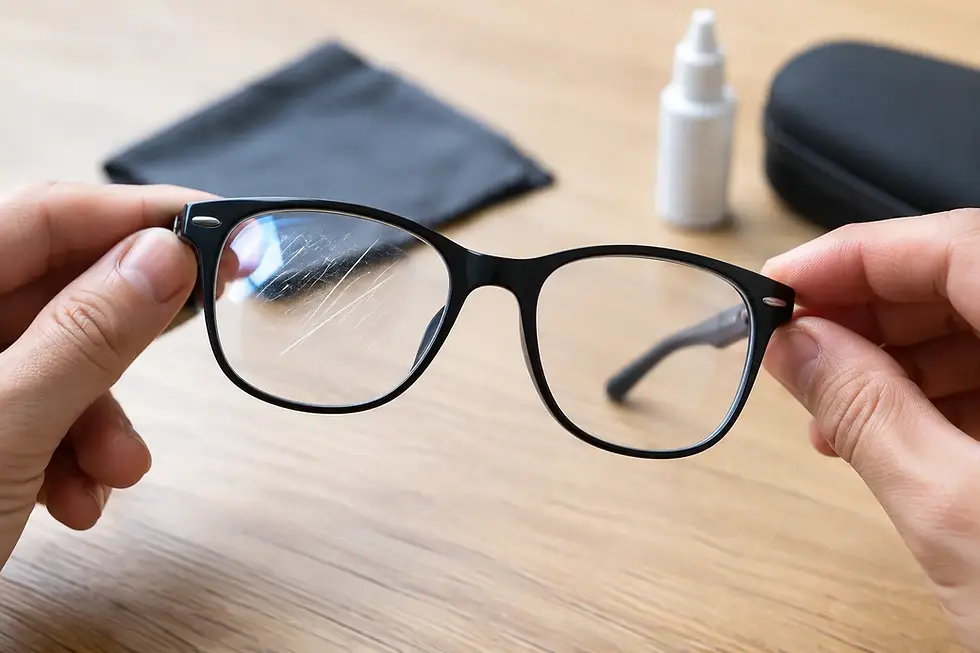
Many premium coatings include easier-clean properties and added resistance to smudges and scratches. They do not make lenses indestructible, so proper care still matters. Rinse away dust before wiping, use a clean microfiber cloth, and avoid dry paper towels or the hem of a shirt, which can create fine scratches over time.
Your glasses should feel like a natural extension of your day, whether you are reviewing a presentation, reading in the carpool line, or driving home after dinner. The right material is the one that respects your prescription while making those everyday moments clearer, lighter, and more comfortable.


Comments