Progressive Lenses Explained: What They Are & Why ZEISS Progressive Lenses Make a Difference


If you're over 40 and finding it harder to read your phone, restaurant menus, or computer screens without adjusting your distance, you've likely experienced presbyopia—the natural age-related loss of near vision. Progressive lenses offer a seamless solution, but not all progressives are created equal.
As an ABO-certified optician with over 10 years of experience, I've helped hundreds of customers transition to progressive lenses. In this guide, I'll explain what progressive lenses are, how they work, and why the technology behind them—especially ZEISS progressive lenses—makes all the difference in your visual comfort and adaptation.
What Are Progressive Lenses?
Progressive lenses (also called progressive addition lenses or PALs) are multifocal eyeglass lenses that correct vision at multiple distances—near, intermediate, and far—without the visible lines found in traditional bifocals or trifocals.
How Progressive Lenses Work
Unlike single-vision lenses that correct only one distance, progressive lenses feature a gradual transition of lens power:
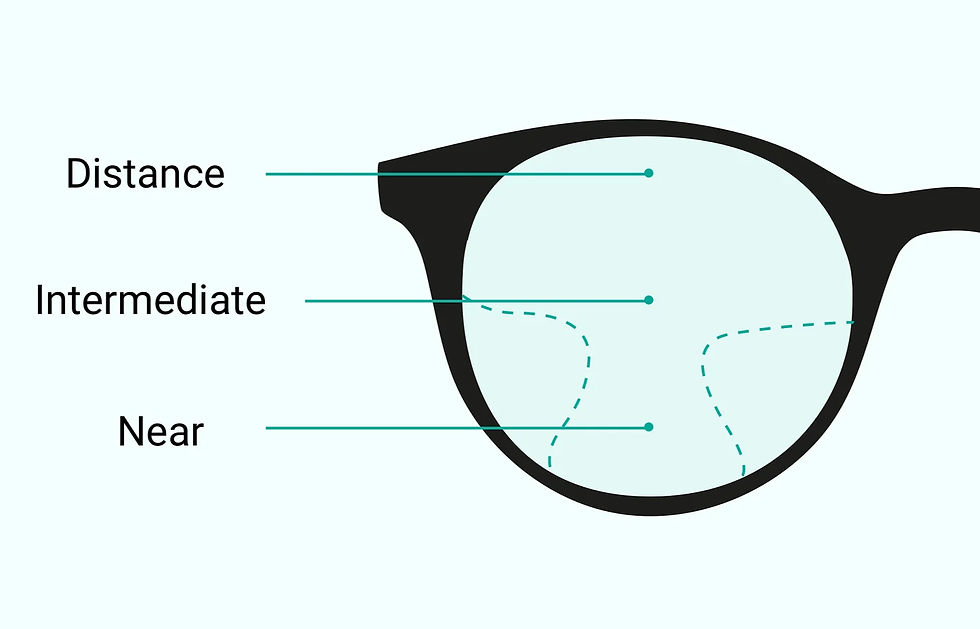
Top portion: Distance vision (driving, watching TV, seeing across a room)
Middle corridor: Intermediate vision (computer work, dashboard, grocery shelves)
Bottom portion: Near vision (reading, phone, close-up tasks)
This seamless gradient allows you to see clearly at all distances by simply adjusting where you look through the lens—no need to switch between multiple pairs of glasses.
Progressive Lenses vs. Bifocals vs. Trifocals
Bifocals
Two distinct vision zones (distance and near)
Visible line across the lens
Abrupt jump between prescriptions
No intermediate vision correction
Trifocals
Three distinct zones (distance, intermediate, near)
Two visible lines
Better for computer work than bifocals
Still has abrupt transitions
Progressive Lenses
Smooth, continuous transition between all distances
No visible lines (aesthetically modern)
Natural vision at every distance
Wider fields of view (with quality progressives)
The advantage? Progressive lenses provide a more natural visual experience and look like regular glasses—no one can tell you're wearing multifocals.
Who Needs Progressive Lenses?
Progressive lenses are ideal if you:
Are over 40 and experiencing presbyopia (difficulty focusing on close objects)
Need correction for multiple distances (nearsighted or farsighted with presbyopia)
Want a modern alternative to bifocals or trifocals
Use computers frequently and need intermediate vision support
Prefer one pair of glasses for all activities
Value aesthetics and don't want visible lines in your lenses
ZEISS Progressive LensES
Not all progressive lenses deliver the same visual experience. The technology, design precision, and customization behind the lens determine how quickly you adapt and how comfortable your vision feels.
Why ZEISS Progressive Lenses Are Different
1. Precision German Engineering
ZEISS has been a leader in optical innovation for over 175 years. Their progressive lens designs use advanced algorithms and manufacturing precision that create:
Wider fields of clear vision at all distances
Smoother transitions between zones (less distortion)
Reduced peripheral blur (common in lower-quality progressives)
2. Customization for Your Eyes & Lifestyle
ZEISS progressive lenses aren't one-size-fits-all. They're calculated based on:
Your exact prescription
Your frame measurements (fitting height, pantoscopic tilt, vertex distance)
Your dominant eye
Your lifestyle needs (office work, driving, hobbies)
This level of customization means faster adaptation and more natural vision from day one.
3. Digital Lens Technology
ZEISS uses digital surfacing technology (also called free-form technology) to create progressive lenses with:
Point-by-point precision across the entire lens surface
Optimized lens power in every viewing zone
Minimal distortion in peripheral areas
The result? You get clear, comfortable vision across the entire lens—not just the center.
4. Advanced Coatings
ZEISS progressive lenses come with premium coatings that enhance your visual experience:
DuraVision Gold: Superior scratch resistance and easy cleaning
Blue light filtering: Reduces digital eye strain from screens
Anti-reflective coatings: Eliminate glare for night driving and computer use
Types of Progressive Lenses (And Which Is Right for You)
Standard Progressive Lenses
Good for general use
Moderate adaptation period
Budget-friendly option
Best for: First-time progressive wearers with basic vision needs
Premium Progressive Lenses (ZEISS SmartLife Individual 3)
Wider fields of view
Smoother transitions
Customized to your prescription and frame
Faster adaptation
Best for: Active lifestyles, frequent computer users, anyone wanting the best visual comfort
Occupational Progressive Lenses (ZEISS Office Lens)
Optimized for near and intermediate distances
Wider computer and reading zones
Not ideal for driving (limited distance vision)
Best for: Office workers, designers, anyone spending extended hours at a desk
Digital Progressive Lenses (ZEISS Digital Lens)
Enhanced intermediate zone for digital devices
Reduces eye strain from phones and tablets
Supports modern screen-heavy lifestyles
Best for: Younger presbyopes or heavy smartphone/tablet users
Common Progressive Lens Concerns (Addressed)
"Progressive lenses are hard to get used to"
Our experience: With quality lenses like ZEISS progressives and proper fitting, most of our customers adapt comfortably within days. Lower-quality progressives with narrow viewing zones can take weeks and may cause more frustration.
"I'll have to move my head a lot"
Our experience: Premium progressives have wide, natural viewing zones. You'll use natural eye and head movements—similar to what you do now. The adjustment feels intuitive rather than forced.
"Progressive lenses make you dizzy"
Our experience: Dizziness typically comes from poor fitting or low-quality lens design. Properly fitted ZEISS progressives minimize distortion and adaptation challenges. If dizziness persists beyond the first few days, we adjust the fit or explore alternative solutions.
"Progressive lenses don't work for everyone"
Our experience: With the right lens design, frame selection, and professional fitting, the vast majority of my customers successfully adapt to progressives. Individual results vary, but proper customization makes a significant difference.
How to Adapt to Progressive Lenses Successfully
The First Week: Initial Adjustment
What you may experience:
Slight awareness of peripheral distortion (normal during adaptation)
Learning to look through the correct zones
Minor balance adjustments when walking
Tips for smoother adaptation:
Wear your progressives consistently (avoid switching back and forth)
Move your eyes first, then your head
Point your nose at what you want to see
Practice on stairs and curbs (look slightly downward)
Week Two: Building Confidence
What you may experience:
Peripheral awareness fades
Natural head and eye movements return
Improved comfort at all distances
Tips:
Try different activities (reading, computer work, driving)
Adjust your reading position (hold materials slightly lower)
Use the intermediate zone for computer screens
Beyond Week Two: Continued Adaptation
Many of my customers report that progressive lenses feel natural and effortless at this stage. Vision becomes comfortable across all distances, though individual adaptation timelines vary.
Choosing the Right Frames for Progressive Lenses
Frame selection matters for progressive lens performance. Here's what to consider:
Frame Height
Minimum 28mm vertical height recommended for standard progressives
Taller frames provide more room for the progressive corridor
Very small or narrow frames may limit lens effectiveness
Frame Fit
Proper fitting height (your pupil position in the lens)
Correct pantoscopic tilt (frame angle)
Appropriate vertex distance (lens-to-eye distance)
Frame Style
Avoid extreme wraparound styles (can distort progressive zones)
Choose frames that sit comfortably on your face
Consider lifestyle needs (sports, office, fashion)
Progressive Lens FAQs
How much do progressive lenses cost?
Progressive lens pricing varies based on technology and customization. Standard progressives typically start around $200-300, while premium ZEISS progressives range from $400-700. The investment reflects the advanced technology, customization, and long-term visual comfort.
Can I use progressive lenses for computer work?
Yes. Premium progressives like ZEISS SmartLife Individual 3 have wide intermediate zones suitable for computer use. For dedicated office work, ZEISS Office Lenses offer even larger computer and reading zones optimized for desk tasks.
Do I need progressive lenses if I'm only 40?
If you're experiencing presbyopia symptoms (difficulty reading, eye strain, holding things farther away), progressive lenses can help. Many people begin using progressive lenses in their early to mid-40s as presbyopia develops.
Can I get progressive lenses in sunglasses?
Absolutely. Progressive lenses work well in sunglasses, especially with polarized or photochromic (transition) options. They're ideal for driving, outdoor activities, and reading outdoors.
What if I don't adapt to progressive lenses?
In our experience, adaptation challenges are uncommon with proper fitting and quality lenses. If you experience persistent problems, we'll work with you to adjust the fit, try different lens designs, or explore alternative solutions that better suit your needs.
Why Choose Optica Caballero for Your Progressive Lenses
Expert Fitting & Measurements
As an ABO-certified optician with over 10 years of experience, we ensure precise measurements for optimal progressive lens performance. Proper fitting is critical to progressive lens success.
ZEISS Lens Partnership
We exclusively use ZEISS progressive lenses—world-class German optics with superior clarity, wider viewing zones, and advanced customization technology.
Personalized Consultation
We discuss your lifestyle, visual needs, and daily activities to recommend the progressive lens design that best fits you—not a one-size-fits-all solution.
Curated Frame Selection
We curate an extensive selection of handcrafted, independent frames in our boutique, each thoughtfully selected for progressive lens compatibility and refined personal style.
Ongoing Support
We're here throughout your adaptation period and beyond. If adjustments are needed, we make it right.
Ready to Experience the ZEISS Progressive Lens Difference?
If you're tired of switching between reading glasses and distance glasses—or if you're ready to upgrade from outdated bifocals—progressive lenses with ZEISS technology offer the visual freedom and comfort you deserve.
Schedule your personalized eyewear consultation today. We'll discuss your vision needs, explain your progressive lens options, and help you find frames that work perfectly with your new lenses.
Optica Caballero | Cypress, TX | Premium Handcrafted Eyewear | World-Class ZEISS Lenses | Over 10 Years of Optical Expertise | ABO Certified


Comments