
Why Do Progressive Lenses Blur at the Edges?

A phone held low, a dashboard at arm’s length, a colleague across the table - progressive lenses are designed to bring each distance into focus without changing glasses. So why do progressive lenses blur, particularly at the edges? Often, the blur is an expected part of the lens design. Other times, it signals that the prescription, measurements, frame fit, or lens design needs a closer look.
Progressives can deliver beautifully natural all-day vision, but they are not one-size-fits-all lenses. The difference between lenses that feel effortless and lenses that feel frustrating usually comes down to how precisely they are selected and fitted for the person wearing them.
Why Do Progressive Lenses Blur in the First Place?
Unlike lined bifocals, progressive lenses create a gradual transition from distance vision at the top of the lens to intermediate vision in the middle and reading vision near the bottom. There is no visible line, but there is a carefully engineered optical compromise: as the prescription changes across the lens surface, unwanted peripheral astigmatism develops along the sides.
That means the clearest viewing areas form a corridor through the center of each lens. Looking straight ahead through the upper portion should provide distance clarity. Lowering your eyes into the middle zone brings a computer screen or dashboard into focus, while the lower area is intended for reading.
The soft blur and slight swim sensation at the outer edges are therefore normal in most progressive designs. Your eyes and brain learn to favor the clear zones, and your head naturally begins to turn toward what you want to see. With a well-designed lens and accurate fitting, this becomes automatic rather than something you consciously manage.
The amount of peripheral blur depends on several variables. A stronger reading addition generally requires a greater change in power from top to bottom, which can make peripheral distortion more noticeable. The width of the frame, the available lens height, the lens design, and your usual working distances all matter as well.
Adaptation Is Real, but It Should Not Be Endless
Most first-time progressive wearers need a short adjustment period. For some, it takes a few days; for others, it can take one or two weeks of consistent wear. During that time, floors may seem slightly tilted, quick side glances can feel soft, and reading may require a more deliberate head position.
The best approach is to wear the new glasses regularly rather than switching back and forth to an older pair. Move your head toward the object you want to view instead of relying on your eyes alone to scan the edges of the lenses. When walking down stairs or stepping off a curb, briefly lower your gaze with care until the movement feels familiar.
Adaptation should trend in the right direction. You should notice that everyday tasks become easier, not increasingly uncomfortable. Persistent nausea, headaches, double vision, significant dizziness, or a narrow central viewing area that makes normal work difficult are not concerns to simply tolerate. They deserve a professional evaluation.
A Precise Fit Changes How a Progressive Lens Performs
A progressive lens is customized optical equipment, not just a prescription placed into a frame. Even an excellent lens design can perform poorly if it sits too high, too low, too far from the eyes, or at an angle that does not match the measurements used to order it.
The fitting height is especially important. It identifies where the distance zone, intermediate corridor, and near area should sit relative to your pupils. If the frame slips down your nose, the reading area can feel too low. If it rides too high, distance vision may feel compromised. Frame adjustments are not cosmetic finishing touches. They are part of the lens performance.
Pupillary distance also needs to be measured accurately for each eye. Many people assume their eyes are perfectly symmetrical, but small differences are common. In premium progressive lenses, additional measurements may include vertex distance, pantoscopic tilt, and frame wrap. These details help position the optics where your eyes actually look through them.
This is one reason a rushed, generic fitting can create unnecessary frustration. At Optica Caballero, the goal is not simply to hand over a finished pair. We take the time to assess how the frame rests, how you carry your head, and what your real visual day requires, then make adjustments as needed.
Lens Design Should Match Your Daily Life
Not all progressive lenses distribute clarity in the same way. Some designs prioritize a broad distance field for driving and walking outdoors. Others emphasize a wider intermediate zone for computer work, meetings, and active multitasking. A person who spends hours moving between dual monitors has different needs from someone who drives throughout Houston, reads on a tablet, and checks a phone between appointments.
Entry-level progressive lenses often use more generalized designs. They can be a reasonable option in the right situation, but they may have narrower usable zones or more noticeable peripheral blur than a personalized design. Premium options, including advanced ZEISS progressive lens designs, can use more individualized wearing parameters and sophisticated calculations to balance the viewing zones more effectively.
That does not mean the most complex lens is automatically right for every wearer. The best choice depends on prescription strength, frame preference, task demands, budget, and adaptation history. A larger frame may provide more room for a comfortable progressive layout, while a shallower fashion frame may call for a design made specifically for limited lens height.
Computer Distance Is Often the Missing Detail
A standard progressive lens covers many distances, but it cannot make every zone equally wide. If your workday centers on a large desktop monitor, multiple screens, or close technical work, your computer may fall into a relatively narrow part of a conventional progressive corridor.
In that case, a dedicated occupational lens can be a thoughtful second pair. It can offer a wider near and intermediate field for desk work, though it is not intended for driving or full-time distance use. For many professionals, having both a daily progressive and a work-specific pair is more comfortable than asking one lens to handle every task perfectly.
When Blur May Point to a Problem
Some blur is built into progressive optics. But blur that stays centered, occurs only in one eye, or appears suddenly after the glasses initially worked well may indicate something else. The prescription may need to be rechecked, particularly if your vision has changed. A lens could have been mounted incorrectly, or the frame may have shifted out of adjustment.
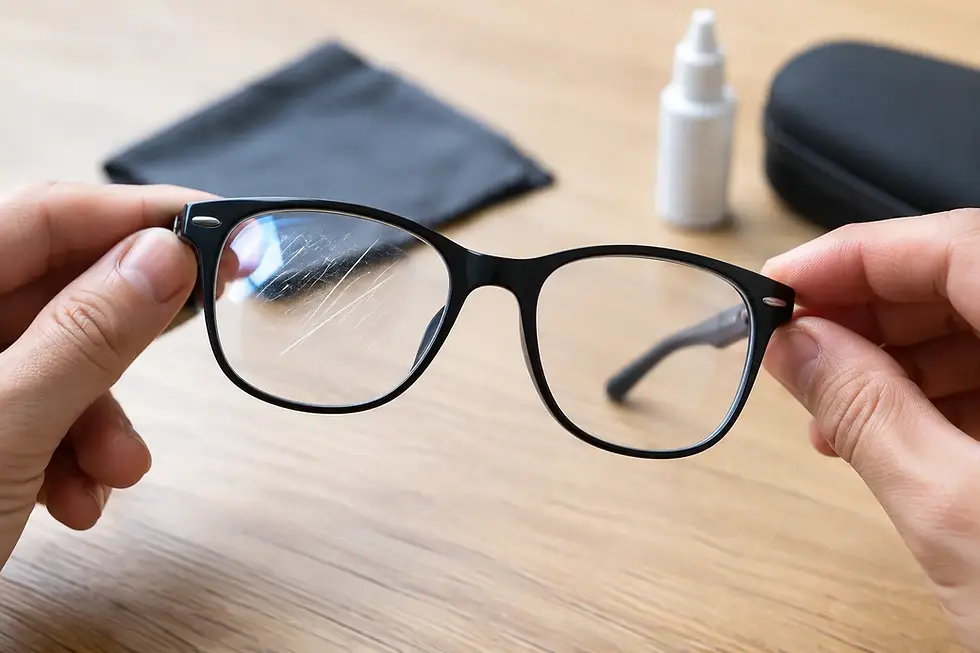
Lens material and coatings can also affect perceived clarity. Smudges, fine scratches, and worn anti-reflective coating are especially distracting at night, when glare from headlights and streetlights makes any imperfection more visible. A quality anti-reflective coating will not remove the inherent peripheral softness of a progressive, but it can reduce distracting reflections and improve contrast in low light.
Dry eyes are another frequently overlooked factor. If vision fluctuates during the day, sharpens after blinking, or becomes worse during prolonged screen use, the issue may be tear-film stability rather than the progressive lens itself. An eye care professional can help distinguish between a lens concern and an eye health concern.
If you experience flashes of light, a sudden increase in floaters, a curtain-like shadow, severe eye pain, or a sudden change in vision, seek prompt medical eye care. Those symptoms are not normal progressive-lens adaptation.
How to Make Progressives Easier to Wear
Start with a frame that fits securely and gives the lens enough vertical space for your prescription and lifestyle. Wear the glasses consistently during the adaptation period, keep them clean, and have the frame adjusted if it begins to slide or sit unevenly.
Most of all, be specific about how you use your eyes. Bring up night driving, hours at a computer, woodworking, golf, travel, phone use, or a favorite reading position. Those details guide the lens recommendation far better than a prescription alone.
Progressive lenses ask a great deal of precision from a small piece of optical equipment. When the design, measurements, frame, and fitting work together, the blur recedes into the background and your day comes back into clear view.


Comments