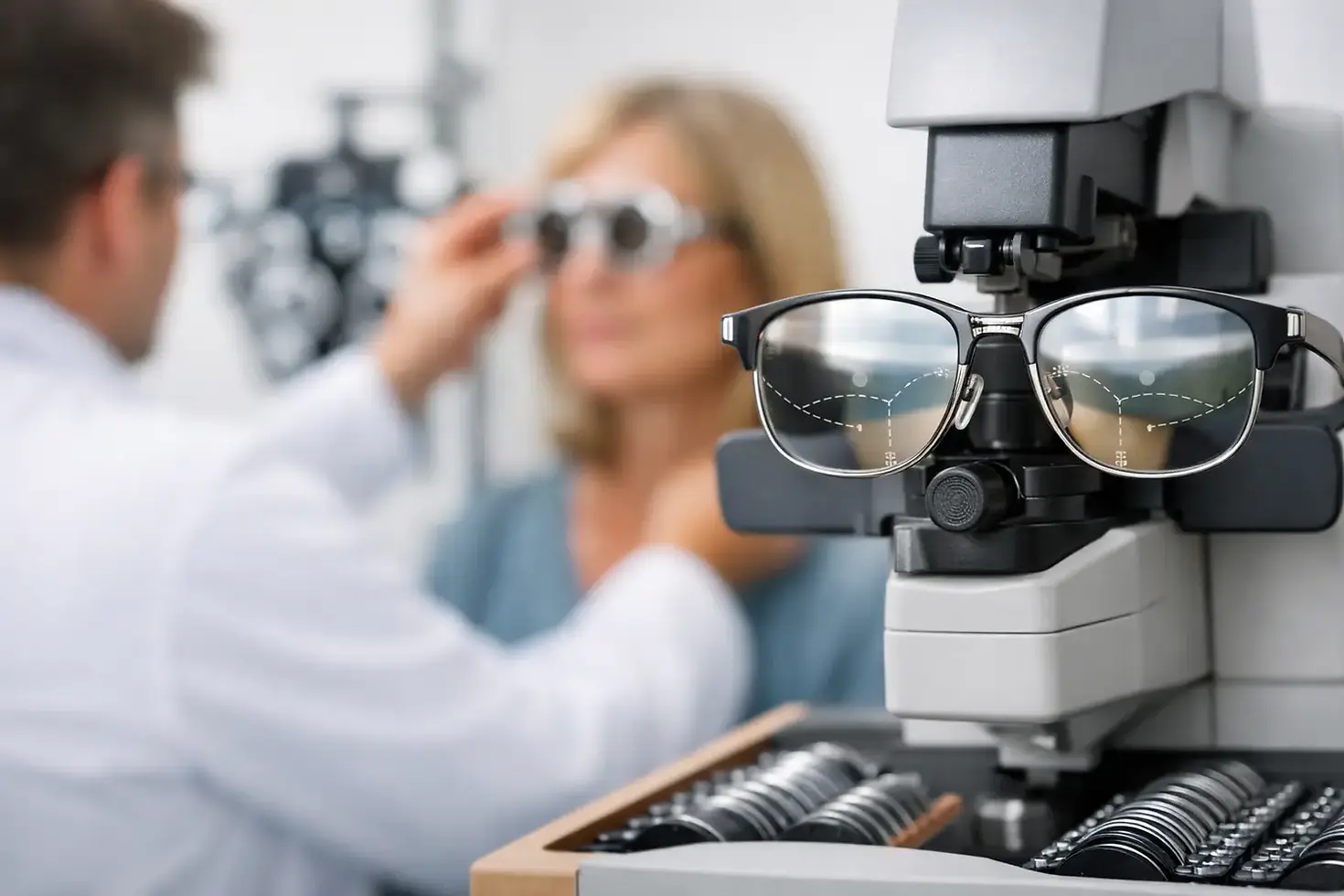
Why Progressive Lens Fitting Needs Precision

A progressive lens can place reading material, a laptop screen, a dashboard, and the road ahead within one pair of glasses. But that convenience depends on far more than the prescription printed on your exam results. Progressive lens fitting is the process of matching the lens design to your eyes, your chosen frame, and the way you actually move through the day.
When the fitting is precise, progressives can feel natural and capable from morning emails to evening driving. When measurements are rushed or a frame is poorly matched to the lens, even an excellent prescription may leave you tilting your head, searching for clear focus, or feeling that the sides of your vision are distorted.
At Optica Caballero, we take the time to get it right. That means understanding your visual habits before recommending a lens, then making detailed measurements with the frame sitting where it should sit on your face - not in a generic position on a display tray.
What Progressive Lens Fitting Actually Measures
Progressive lenses have a gradual change in prescription from the upper portion of the lens for distance vision to the lower portion for near work. Between those areas is an intermediate zone designed for tasks such as computer use, cooking, shopping, and seeing a passenger across the table.
Unlike lined bifocals, there is no visible dividing line. The trade-off is that a progressive lens must be positioned very accurately. Its clearest viewing channels need to align with where your eyes naturally look.
A proper fitting begins with pupillary distance, or PD, which measures the position of each pupil. For progressive lenses, individual monocular measurements are especially valuable because faces are not perfectly symmetrical. Measuring both eyes as one total number can miss small differences that matter in a personalized lens design.
The optician also records fitting height. This is the vertical position of your pupil within the selected frame. If the height is too low, the reading zone may be difficult to reach. If it is too high, distance vision can feel compromised. A few millimeters can change the experience considerably.
Additional measurements may include the frame's vertex distance, or how close the lenses sit to your eyes, along with the frame's pantoscopic tilt and wrap. Those details sound technical, but they affect real outcomes: how comfortably you can read, how wide the useful viewing areas feel, and how consistently the prescription performs when you turn your head or glance down.
The Frame Is Part of the Prescription
A favorite frame is not automatically the best frame for every progressive lens. The frame needs enough vertical depth to comfortably accommodate distance, intermediate, and near viewing zones. A very shallow frame may work for some prescriptions and lens designs, but it can limit the near area or require more intentional head movement.
This does not mean progressive wearers must choose oversized glasses. Modern premium designs can work beautifully in many refined, smaller frame shapes when the fitting is planned carefully. The question is not simply whether a frame can hold a progressive lens. It is whether it gives you the visual range you need without sacrificing comfort or style.
Frame fit also changes after you leave the optical shop. If a frame slides down your nose, the lens zones slide with it. If the temples are too loose, the frame can shift as you look down at a phone or turn your head while driving. That is why a final adjustment is not a cosmetic extra. It is part of the lens fitting.
For people who wear their glasses all day, a lightweight frame with stable bridge support can make a meaningful difference. It helps keep the lenses in the same intended position, whether you are in a meeting, picking up children, or spending an afternoon outdoors.
Your Routine Should Shape the Lens Design
There is no single “best” progressive lens for everyone. The right design depends on your prescription, previous experience with progressives, frame choice, and daily tasks.
A client who spends long hours switching between multiple monitors may benefit from a lens design with a generous intermediate zone. Someone who drives frequently on Houston-area roads, especially after dark, may prioritize stable distance vision, clear dashboard viewing, and a premium anti-reflective coating that reduces distracting glare. A frequent traveler may want an all-purpose design that handles navigation screens, airport signs, reading, and sightseeing without changing glasses.
Reading posture matters, too. Some people hold books close. Others prefer a tablet at arm's length. A business owner may frequently look across a desk at clients, while a hobbyist may need close focus for detailed handwork. These are not minor preferences. They help determine which progressive design will feel most intuitive.
ZEISS progressive lens technology offers options tailored to different visual demands, including designs intended to provide broad, comfortable viewing areas and more individualized performance. The benefit is not technology for its own sake. It is a lens that supports the way you use your eyes throughout the day.
Why Adaptation Is Different for Everyone
Many first-time progressive wearers adapt quickly, sometimes within a few days. Others need one to two weeks as their eyes and brain learn to use different zones of the lens. This adjustment period is normal, particularly if you are moving from reading glasses or lined bifocals.
During adaptation, it helps to point your nose toward what you want to see rather than relying only on your eyes to look far to the side. When reading, lower your gaze through the near portion of the lens. For stairs and curbs, use the distance area and move at a comfortable pace until the new lens feels familiar.
Still, adaptation should not mean simply enduring poor vision. Persistent headaches, nausea, blurred distance vision, difficulty finding the reading area, or a feeling that the floor is swimming can signal a fitting issue, a frame adjustment need, or a lens design that does not suit your lifestyle. The right response is a follow-up conversation, not frustration.
A careful optician will distinguish between ordinary adaptation and a problem that deserves correction. Small adjustments to the nose pads, temple fit, frame angle, or position can sometimes make a surprisingly large difference.
Common Fitting Mistakes That Affect Comfort
The most common issue is treating progressive lenses like a commodity. A prescription may be accurate, but the finished eyewear can still underperform if measurements were taken quickly, the frame was not adjusted before measuring, or the wearer’s habits were never discussed.
Another mistake is ordering a lens based only on price or a familiar brand name. Value matters, but a less personalized design may have narrower usable zones or less comfortable peripheral vision for certain prescriptions. Conversely, the most advanced lens is not automatically necessary for every wearer. The best choice should reflect what you do, what you see, and what you expect from your glasses.
It is also easy to overlook coatings. A premium anti-reflective coating can improve clarity by reducing reflections on the front and back of the lens. For drivers, screen users, and anyone frequently under overhead lighting, that reduction in glare can make vision feel cleaner and less tiring. Photochromic options may add convenience for those moving between indoor and outdoor settings, though they do not replace dedicated sunglasses for every bright driving situation.
A Better Progressive Lens Fitting Experience
The fitting appointment should feel unhurried. First, your optician should ask practical questions: How much time do you spend on screens? Do you drive at night? Do you wear your glasses from morning until bedtime? What has worked - or not worked - in previous pairs?
Next comes frame selection with lens performance in mind. You should be able to choose a frame that feels like you while also supporting the visual zones you need. Once the frame is adjusted to sit correctly, precise measurements can be taken in your natural posture.
Finally, the relationship should continue after pickup. Your new eyewear may need a refinement after a few days of wear, especially as the frame settles and you become more aware of how you use it. Ongoing adjustments are a practical part of protecting your investment in premium lenses and a carefully chosen frame.
A well-fitted progressive pair should not demand constant attention. It should help you move from a presentation to a text message, from a grocery list to the road ahead, with less effort and more confidence. Your vision deserves more than a transaction - it deserves the care, precision, and follow-through that make everyday sight feel comfortably your own.


Comments